
Ariel: Science, Mission & Community 2026
The Ariel Mission Consortium and ESA Ariel Science Team are delighted to invite the international scientific community to attend the Ariel Open Conference 2026, hosted at the ESA Magali Vaissiere Conference Centre, in the Harwell Campus in the UK.
The conference “Ariel: Science, Mission & Community 2026” will provide an overall summary of the Ariel’s science, instrument and operations and present the many activities that the Ariel team have planned to engage the science community at large and the public. These include educational and citizen-science programs such as ExoClock and the Ariel Data Challenges. Contributions and feedback from the attendees are welcomed through oral and poster presentations (submit your abstract here), and focused panel discussions.
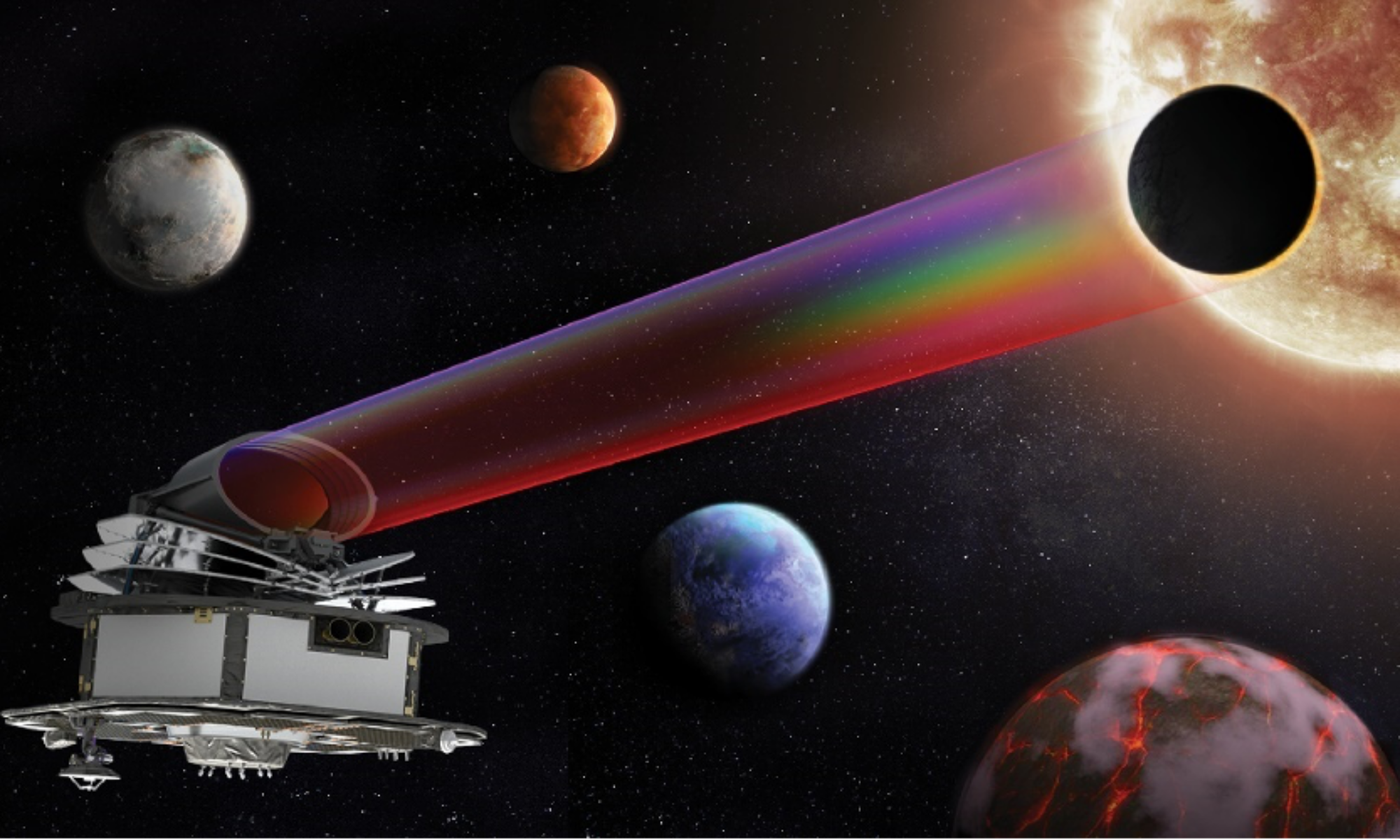
About Ariel – The Ariel space telescope, to be launched at the end of this decade as part of the ESA Science Programme, is the first mission dedicated to the determination of the chemical composition and thermal structure of hundreds of exoplanets, enabling planetary science far beyond the boundaries of the Solar System. Ariel has been conceived to deliver a spectroscopic survey of ~ 1000 transiting exoplanets, covering simultaneously the range 0.5-7.8 micron, and probing uniformly the gamut of planetary and stellar parameters.
The Ariel payload is developed by a consortium of more than 50+ institutes from 16 ESA countries, which include the UK, France, Italy, Belgium, Poland, Spain, Austria, Denmark, Portugal, Ireland, Czech Republic, Hungary, the Netherlands, Sweden, Norway, Estonia, with important contributions from NASA, JAXA and CSA.
More information about Ariel can be found here
Venue & Dates
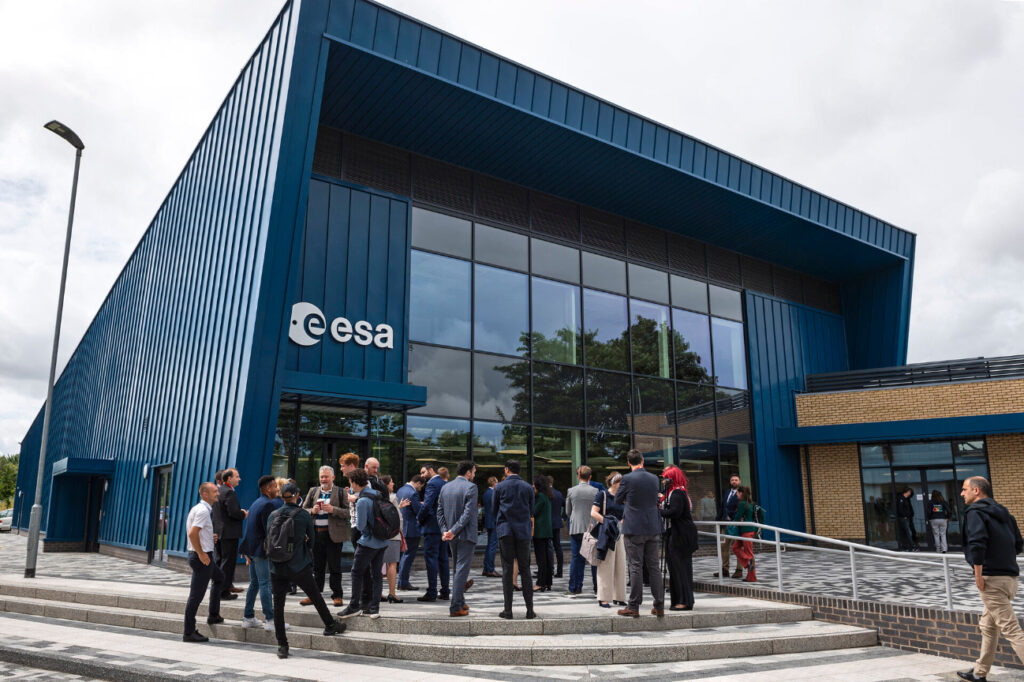
The event will be held between 17 to 19 March 2026 in the ESA’s Magali Vaissiere Conference Centre, located beside ESA ECSAT, Harwell Campus.
Venue: ESA Magali Vaissiere Conference Centre
Fermi Avenue
Harwell Campus
Didcot, Oxfordshire, OX11 0FD
United Kingdom
How to get there
Registration fees include coffee breaks and lunches. Early registration fee (until November 10th) is €275. Late registration fee (10 November – 28 February) is €350. A limited number of discounted fees/fee waivers is available for students and early career scientists. Applications are accepted until November 10th using the abstract submission page.
Looking forward to seeing you at the conference in March 2026!
Questions? You can contact us at openconference2026 at arielmission.space
Abstract submission is now only open for poster contributions
Agenda
Final program
Tuesday, 17th March
| Time | Topic | Speaker |
|---|---|---|
| 8:30 – 9:30 | Welcome and registration | |
| 9:30 – 12:30 | The ESA Ariel Mission, Science, Targets and Mission properties Chairs: Giusi Micela (INAF, OaPa) and Theresa Lueftinger (ESA) | |
| 09:30 – 09:45 | ESA Exoplanet Missions & Ariel in context, AST, ESA Open Calls | Theresa Lueftinger (ESA) |
| 09:45 – 10:00 | Ariel Overview | Giovanna Tinetti (King’s College London) |
| 10:00 – 10:15 | ESA Ariel Programme | Jean-Christophe Salvignol (ESA) |
| 10:15 – 10:30 | Ariel payload | Paul Eccleston (RAL Space) |
| 10:30 – 10:45 | Ariel Ground Segment | Anja Hofmann (ESA), Chris Pearson (RAL) |
| 10:45 – 11:15 | Coffee break | |
| 11:15 – 11:30 | How does Ariel Target Candidate Selection work? | Billy Edwards (SRON) |
| 11:30 – 11:45 | Optimising Ariel observational strategy (Tiers, Phase-curves) | Nic Cowan (McGill) |
| 11:45 – 11:55 | ExoClock | Anastasia Kokori (UCL) |
| 11:55 – 12:05 | The Ariel Simulation Framework, from radiometric budgets to end-to-end performance assessment | Lorenzo Mugnai (U. of Cardiff) |
| 12:05 – 12:15 | ExoDB | Ahmed Al-Refaie (UCL), Arun Nambiyath Govindan (UCL) |
| 12:15 – 13:15 | Lunch break | |
| 13:15 – 13:45 | Keynote talk: Characterization of exo-planets’ composition: towards a global understanding of their origin and evolution | Doug Lin (UC Santa Cruz) |
| 13:45 – 15:05 | Discs & Planet Formation (Chair: Sudeshna Boro Saikia, U. of Vienna) | |
| 13:45 – 14:05 | Invited: JWST reveals the impact of protoplanetary disk ice chemistry on exoplanet compositions | Melissa Mc Clure (U. of Leiden) |
| 14:05 – 14:20 | From Discs to Planets: How Planet Formation Shapes Planetary Compositions | Elenia Pacetti (INAF-IAPS) |
| 14:20 – 14:35 | Rethinking Debris Discs: How Gas Reshapes the Architecture of HD 131488 | Shivam Joshi (U. of Vienna) |
| 14:35 – 14:50 | Toward Characterization of Young Transiting Planets with Ariel | Norio Narita (U. of Tokyo) |
| 14:50 – 15:05 | Testing the Origin of Hot Jupiters with Ariel | Lina D’Aoust (U. of Waterloo) |
| 15:05 – 15:35 | Coffee break | |
| 15:35 – 17:15 | Properties of host stars & star-planet interactions (Chair: Bart Vandenbussche, KU Leuven) | |
| 15:35 – 15:55 | Invited: How does the Galactic Environment Shape Planet Populations? Implications for Ariel and atmospheric demographics. | Dolev Bashi (Cambridge University) |
| 15:55 – 16:10 | Characterising the host stars that will shape Ariel’s exoplanet science | Maria Tsantaki (Obs. of Arcetri) Camilla Danielski (U. of Valencia)) |
| 16:10 – 16:25 | The Gr8stars catalogue of homogeneously derived parameters for bright FGKM dwarfs and its impact in investigating spectroscopic method systematics. | Alix Violet Freckelton (U. of Birmingham) |
| 16:25 – 16:45 | Invited: Star-Planet Interactions: why our favourite exoplanets have extra interesting physics going on | Katia Poppenhaeger (Leibniz-Institut für Astrophysik Potsdam) |
| 16:45 – 17:00 | Upper atmospheres and star-planet interactions in the Ariel context | Antonio Garcia Munoz (CEA) |
| 17:00 – 17:15 | Assessing the Sensitivity of the Ariel Tier Strategy to Stellar Variability | Alex Thompson (ESA, INAF) |
| 17:15 – 17:30 | Measuring the scales of convection using planetary transits | Nina-Elisabeth Nemec (ICE-CSIC) |
| 17:30 – 18:15 | Poster Pitch session Chairs: Quentin Changeat (U. of Groningen) and Miriam Rengel (MPS) |
Wednesday, 18th March
| Time | Topic | Speaker |
|---|---|---|
| 8:30-9:30 | Welcome and registration | |
| 9:30 – 11:30 | Exoplanet Demographics – Exoplanet Detection and Characterisation Chair: Sarah Casewell (U. of Leicester) | |
| 9:30 – 9:50 | Invited: Exoplanets detected and characterised by direct imaging | Anne Marie Lagrange (Obs. de Paris, CNRS) |
| 9:50 – 10:10 | Invited: Gaia Astrometry and Exoplanets: Towards DR4 and DR5 | Alessandro Sozzetti (INAF, OATo) |
| 10:10 – 10:30 | Invited: Exoplanets detected and characterised by radial velocity | Sharon Xuesong Wang (Tsinghua University) |
| 10:30 – 10:45 | The Ariel Masses Survey at TNG: delivering robust mass measurements for planets in the Radius Valley | Serena Benatti (INAF – OAPa) |
| 10:45 – 11:00 | Atmospheric characterisation of new temperate Jupiters around bright stars from TESS+NGTS | Peter Wheatley (U. of Warwick) |
| 11:00 – 11:30 | Coffee break | |
| 11:30 – 16:20 | Atmospheric models & observations Chairs: Billy Edwards (SRON) and Nic Cowan (McGill) | |
| 11:30 – 11:50 | Invited: Exoplanet atmospheres revealed: insights from JWST | Nestor Espinoza (Space Telescope Science Institute) |
| 11:50 – 12:05 | A systematic analysis of exoplanet transmission spectra with JWST-MIRI | Martin Binet (U. of Cambridge) |
| 12:05 – 12:20 | JWST and cross-correlation techniques: An isotopologue-sensitive technique for exoplanet atmospheric studies | Emma Esparza Borges (IAC) |
| 12:20 – 13:20 | Lunch break | |
| 13:20 – 13:35 | Large-Scale Population Study of Exoplanetary Atmospheres Across Known Types to Prepare the Ariel Mission Observation Tier Strategy | Sushuang Ma (KCL) |
| 13:35 – 13:50 | Eclipse Mapping with Ariel: Future Prospects for a Population-Level Mapping Survey | Daniel Valentine (U. of Bristol) |
| 13:50 – 14:05 | Assessing Ariel’s Potential for Low-Density Exoplanet Characterization | Achrène Dyrek (STSci) |
| 14:05 – 14:20 | Probing Exoplanetary Deformation with Ariel | Vanesa Ramirez (Obs. of Leiden) |
| 14:20 – 14:35 | HERMES: HiERarchical Modelling for Exoplanet Science | Syed Wasi Mohsin Naqvi (McGill) |
| 14:35 – 14:55 | Invited: Challenges for Atmospheric Modelling: Climates, Clouds, and Chemistry | Robin Baeyens (U. of Amsterdam) |
| 14:55 – 15:10 | Impact of Photochemical Haze on Chemistry in Hot-Jupiters: Key Implications for Ariel Interpretations | Mei Ting Mak (U. of Oxford) |
| 15:10 – 15:25 | 3D Chemistry of Dynamic Hot/Warm Gas Giants | Harry Baskett (U. of Exeter) |
| 15:25 – 15:55 | Coffee break – Conference photo outside the venue | |
| 15:50 – 16:05 | Development of an experimentally validated P/H/O mechanism for studying hydrogen-dominated exoplanet atmospheres | Axelle Le Cadre (Lisa, CNRS) |
| 16:05 – 16:20 | ExoMol | Jonathan Tennyson (UCL) |
| 16:20 – 17:00 | From the solar system to exoplanets Chair: Miriam Rengel (MPS) | |
| 16:20 – 16:40 | Invited: The Submillimetre Wave Instrument on JUICE | Paul Hartogh (Max Planck Institute for Solar System Research) |
| 16:40 – 16:55 | Venus – an “exoplanet” next door | Dmitrij Titov (Sun Yat-Sen University) |
| 16:55 – 18:00 | Poster session II | |
| 18:15 | Buses to conference dinner in Oxford (Keble College) |
Thursday, 19th March
| Time | Topic | Speaker |
|---|---|---|
| 9:30 – 11:35 | Interiors & connection to atmospheres Chair: Jérémy Leconte (U. of Bordeaux) | |
| 09:30 – 09:50 | Invited: Feeding the atmosphere from the interior: Predicted diverse atmospheric evolution pathways for rocky exoplanets | Lena Noack (Freie Universität Berlin) |
| 09:50 – 10:05 | On the connection between observed atmospheric abundances and planetary interiors and evolutions | Darius Modirrousta-Galian (Tsung-Dao Lee Inst.) |
| 10:05 – 10:20 | Blurring the line: Evolution of sub-Neptunes using coupled interior-atmosphere models | Marie-Luise Steinmeyer (ETH) |
| 10:20 – 10:35 | Retrieval Framework for Magma-Ocean Characterization on Sub-Neptunes | Yuichi Ito (NAOJ) |
| 10:35 – 10:50 | The Geoastronomy of Sub-Neptunes | Kevin Heng (LMU) |
| 10:50 – 11:05 | Unraveling the origin of giant exoplanets: Observational implications of convective mixing | Henrik Knierim (U. of Zurich) |
| 11:05 – 11:35 | Coffee break | |
| 11:35 – 14:45 | Synergies with other missions and observatories Moderators: Pierre-Olivier Lagage (CEA) and Quentin Changeat (U. of Groningen) | |
| 11:35 – 11:50 | Invited: NASA TESS | George Ricker (Massachusetts Institute of Technology) and David Ciardi (IPAC) |
| 11:50 – 12:05 | Invited: Characterising Exoplanets Together: Synergies between CHEOPS and Ariel | Monika Lendl (Université de Genève) |
| 12:05 – 12:20 | Invited: ESA PLATO | Magali Deleuil (Laboratoire d’Astrophysique de Marseille) |
| 12:20 – 12:35 | Invited: NASA Nancy Roman | Scott Gaudi (Ohio State University) |
| 12:35 – 12:50 | Invited: The Earth 2.0 (ET) Space Mission | Jian Ge (Shanghai Astronomical Observatory) |
| 12:50 – 13:00 | Synergy JWST – Ariel | Quentin Changeat (U. of Groningen) |
| 13:00 – 13:10 | BSSL Mauve | Arianna Saba (BSSL) |
| 13:10 – 14:10 | Lunch break | |
| 14:10 – 14:45 | Synergy Panel discussion | |
| 14:45 – 15:30 | Complementary Science and Community Engagement Chair: Theresa Lueftinger (ESA) | |
| 14:45 – 15:00 | The Ariel Complementary Science Programme | Matt Griffin (U. of Cardiff) |
| 15:00 – 15:15 | Potential of complementary science observations of young stellar objects and circumstellar disk transient phenomena with Ariel | Csaba Kiss (Konkoli Obs.) |
| 15:15 – 15:30 | Ariel – the weather satellite for free-floating planets | Roman Akhmetshyn (McGill) |
| 15:30 – 16:00 | Coffee break | |
| 16:00 – 17:00 | AI and Data science & panel discussion Moderators: Kai Hou Yip (KCL) and Luís F. Simões (ML Analytics) | |
| Ariel Data Challenges – a review | Kai Hou Yip (KCL) | |
| Flow Matching Posterior Estimation for Exoplanetary Atmospheric Retrieval | Massimiliano Giordano Orsini (U. of Naples) | |
| Exploring the Black Box: What Neural Networks Really Learn About Exoplanet Atmospheres | Antonia Vojtekova (UCL) | |
| A conditional transformer based generative model for planetary systems | Sara Marques (U. of Bern) | |
| Using neural networks to infer the interiors of observed super-Earths and sub-Neptunes | Jo Ann Egger (ESA) | |
| Is machine learning applicable there? Safety cages for operational range bounding of spectroscopy models | Luís F. Simões (ML Analytics) | |
| 17:00 – 18:00 | Feedback about Ariel from participants (chaired by Ariel science team) | All participants |
SOC:
- Sudeshna Boro Saikia (University of Vienna, AT),
- Sarah Casewell (University of Leicester, UK)
- Quentin Changeat (University of Groningen, NL)
- Nicolas Cowan (McGill University, CA),
- Camilla Danielski (University of Valencia, ES),
- Paul Eccleston (RAL Space, UK),
- Billy Edwards (SRON, NL),
- Davide Gandolfi (Turin University, IT),
- Masahiro Ikoma, (The University of Tokyo, JP),
- Pierre-Olivier Lagage (CEA, FR),
- Jeremy Leconte (CNRS, FR),
- Theresa Lueftinger (Co-Chair, ESA/ESTEC, NL),
- Zita Martins, (Universidade de Lisboa, PT),
- Giusi Micela (INAF, IT),
- Enzo Pascale (La Sapienza U. of Rome, IT),
- Miriam Rengel (MPS Göttingen, DE)
- Mark Swain (NASA/JPL, US),
- Giovanna Tinetti (Co-Chair, King’s College London, UK),
- Bart Vandenbussche (KU Leuven, BE),
LOC:
- Rachel Drummond (RAL Space, UK),
- Ezgi Guler (ESA/ECSAT, UK),
- Wendy Elderfield (ESA/ECSAT, UK),
- Costanza Azzini (KCL, UK),
- Arun Nambiyath Govindan (UCL, UK),
- Heleri Ramler (U. of Tartu, EE)
- Paul Eccleston (RAL Space, UK),
- Giovanna Tinetti (KCL, UK)
Accommodations
A list of accommodations close to the conference centre is available here.